 In the spring of 1942, George Takei and his family were forcibly removed from their home in Los Angeles, subject to internment as people of Japanese descent living in the United States during World War II. George was five years old. Their next stop was a literal horse stable, where they would spend months before being moved to a series of camps, little better than prisons, where they would be surrounded by barbed wire fences and watched by armed guards.
The family would not be granted their freedom until three years later, once the internment policy was abolished, and it would be decades before George Takei would take up performance arts and eventually land his most enduring acting role, that of helmsman (and later captain) Hikaru Sulu in various incarnations of Star Trek.
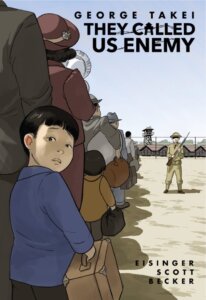
In 2019, Takei published a memoir about the experience, titled They Called Us Enemy, along with co-authors Justin Eisinger and Steven Scott, and illustrator Harmony Becker. (The acknowledgements suggest Takei’s husband Brad also had a significant role to play, behind the scenes). It’s well worth a read.
The mention of an illustrator is important, because this book is richly illustrated — in fact, it’s comics. (Specifically, the publishers call it a “graphic memoir.”) It combines true-life facts and events with elements of visual interpretation and whimsy that comics can uniquely provide, similar to such works as Alison Bechdel’s Fun Home or Art Spiegelman’s Maus.
Because Takei endured his experiences at such an early age, many of his memories are half-formed, and some have only crystalized following conversations with his father, years later. Other memories he recalls with the clarity of those moments that uniquely impact a child’s mind, such as the discovery that his mother had smuggled her sewing machine with her to the camp, even though it was against the rules, so she could continue making clothes for the children. On another occasion, he recalls the Santa Claus who visited the camp but who, to his dismay, was clearly not the genuine article.
Within the camps, not all the older interned reacted to their situation the same way. Takei’s parents, while embittered at the indignity of their incarceration, insisted that they were loyal Americans. Other like-minded displaced people organized in protest of the internment policy. But still others reacted with anger and outward resentment, swearing loyalty to Japan and chanting pro-Hirohito slogans.
In response to this mounting dissent, the U.S. government declared that all interned Japanese would need to sign a questionnaire in which they were asked to assert their willingness to fight in the U.S. military and to foreswear all loyalty to Japan and its emperor. After careful deliberation, Takei’s parents chose to answer “no” to both questions, out of conscience. That choice meant the family would be sent to an even more restrictive camp, as “potential troublemakers.”
Outside young George’s half-formed understanding, the adult world was reacting to the reality of Japanese internment in varying ways. For example, there was the kindly Quaker bookstore owner who recognized the injustice of the policy and delivered books to the camps and ran errands for the interned. On the other hand, there were those who harassed and antagonized the bookseller for his supposed un-American activities.
Anti-Japanese sentiment and racism were still rife outside the camps, even long after the internment policy was ended. In one of the more heartbreaking moments in They Called Us Enemy, once the Supreme Court declared the policy of interning U.S. citizens unconstitutional in 1944, some families chose to renounce their citizenships, so that they would continue to be held in the camps. That way, they reasoned, they could at least temporarily protect their families from the anti-Japanese prejudice and potential violence on the outside.
Eventually, with the help of a sympathetic attorney, Takei’s family would be released from internment along with hundreds of others. After years of captivity, they were free to move anywhere they wanted in the United States — that is, anywhere that would have them. They settled, at least at first, in a squalid hotel in Los Angeles’ Skid Row.
Takei’s story continues after his release from internment. Not surprisingly, as a young man he took part in activism, including meeting and marching with Martin Luther King Jr. He also met Eleanor Roosevelt, although his father declined the same opportunity; he refused to shake hands with the woman whose husband had imprisoned his family.
Takei’s activism continues to this day, his voice much amplified by his fame as Star Trek’s Mr. Sulu. They Called Us Enemy is but another example of his efforts. As he notes in the book, Japanese Americans in World War II are by no means the last people to be mistreated and denied their human dignity by the government of the United States.
As a memoir, The Called Us Enemy works well in the comics format. At just over 200 pages, it’s a brisk read, but it’s dense enough with information and personal perspective to be a moving and important document of history. More importantly, it’s suitable for audiences of diverse ages and backgrounds. It would make a good addition to public and school libraries, and it probably belongs in both.
Speaking of which, from March through May 2026, libraries up and down the West Coast participated in “One Book, One Coast,” in which the libraries rally around a single book and encourage reading, discussion, and activities. This year’s pick was They Called Us Enemy, and it was a fine choice. If your local library similarly has copies available, I wholeheartedly encourage you to, literally, go check it out.