
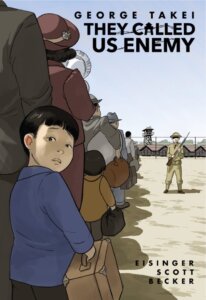
 In the spring of 1942, George Takei and his family were forcibly removed from their home in Los Angeles, subject to internment as people of Japanese descent living in the United States during World War II. George was five years old. Their next stop was a literal horse stable, where they would spend months before being moved to a series of camps, little better than prisons, where they would be surrounded by barbed wire fences and watched by armed guards.
The family would not be granted their freedom until three years later, once the internment policy was abolished, and it would be decades before George Takei would take up performance arts and eventually land his most enduring acting role, that of helmsman (and later captain) Hikaru Sulu in various incarnations of Star Trek.
In 2019, Takei published a memoir about the experience, titled They Called Us Enemy, along with co-authors Justin Eisinger and Steven Scott, and illustrator Harmony Becker. (The acknowledgements suggest Takei’s husband Brad also had a significant role to play, behind the scenes). It’s well worth a read. » More... »

 I don’t read a lot of memoirs. None, really. I can get behind a good biography, and maybe even an autobiography, sometimes. But the idea of slogging through a few hundred pages of the self-important reminisces of someone gazing through the lens of their own nostalgia appeals to me about as much as being FedExed the plates from whatever they ate for dinner last night. But when I heard famous NSA whistleblower Edward Snowden had published such a book, my curiosity got the better of me and I picked up a copy. For the most part, it was worth it.
  What an odd bird is Rambo: Last Blood. I had to watch it—I’m an American male of a certain age, and I grew up with the Rambo character. But what this movie was, I’m not quite sure. (Also, I was one of three people in the theater, on opening Friday night at 7pm.)
 If you stumbled across this article because of a web search, chances are you already know that Glenn Danzig (he of Misfits, Samhain, and his eponymous band) has made a movie. You probably know it’s called Verotika, and that it’s based on various works published by his comic book company of the same name. And you’ve probably heard it’s bad. Like, really bad. All these things are true.
 When Netflix released Devilman Crybaby last year, I enjoyed the anime, but it made me realize that although I was cursorily familiar with the character, I had never really gone back and read Go Nagai’s original manga from the early 1970s. When I found out that Seven Seas Entertainment had released Devilman: The Classic Collection in two volumes the same year, I decided to check it out. And what a ride it is.