
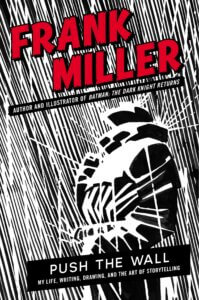
 I honestly wasn’t sure what to expect when I picked up a copy of Push the Wall, the new autobiography by comics artist Frank Miller—he of Batman: The Dark Knight Returns and Sin City fame. Would the book be full of pointless, juvenile observations, like his book-length co-interview with Will Eisner? Would it be replete with self-aggrandizing rants, perhaps sprinkled with some of the fascist rhetoric that has increasingly crept into his work? Or would it be a, uh … sober look back at his life and achievements?
In short, how much bullshit would I have to put up with?
Thankfully, the answer is not all that much. While it’s occasionally meandering and probably not of much interest to people who aren’t themselves inclined to make comics, on the whole it’s a thoughtful, engaging, well-written look at an artist’s life—and the art life, in general.
The prologue had me a little worried. Described as “A Letter to My Younger Self,” it’s written in a second-person perspective that stays annoying across all nine pages. That ends there, though. For the rest of the book, it’s a pretty standard memoir, albeit written in the style of someone who might need to put down the pulp crime novels every once in a while.
There’s a fair amount of typical autobio stuff in there. He talks about his childhood in Vermont, moving to New York City in the 1970s, what life was like in those days, and so on; all familiar stuff if you’ve ever read interviews with him. He was broke, he met some nice women, he really wanted to break into comics.
He talks about the art, books, and comics that influenced him along the way. There were the EC Comics of the 1950s, especially Johnny Craig’s “Crime SuspenStories.” Later he was introduced to European comics and Japanese manga, gravitating toward the likes of Moebius, Druillet, Hugo Pratt, and Goseki Kojima’s Lone Wolf and Cub. Maybe I shouldn’t have been surprised that he’s a big fan of Bill Watterson’s Calvin and Hobbes, too. And he reserves special reverence for two greats no longer with us, Will Eisner and Neal Adams, whom he considered friends and mentors.
Even more interesting (to some), he often includes details of his creative process, along the way. He wastes no time before leaping into tips about how to construct plots and introduce characters. He talks about what makes a good narrative, and why he made some of the more important storytelling decisions in his career (such as killing off Elektra, his beloved supporting character from Marvel Comics’ Daredevil). His writing tips may seem old-hat or obvious to some, but he doesn’t belabor his points.
He also talks about his visual art process. There’s a photo of his battered art table at the front of the book. He talks about his materials (India ink, pricey sable watercolor brushes, liquid frisket, opaque white). He talks about how he uses sketchbooks, as well as how he attacks the blank page. He even describes a time he cut up one of his own pages with scissors and pasted the panels onto new boards with a new arrangement, then handed them to a long-suffering Klaus Janson for inking. It’s unlikely that this material will be interesting to people who don’t foresee themselves doing traditional comics illustration, but these sections were enjoyable to a guy like me.
And that’s about the sum of it. The book is a combination of memoir and advice to creative types, presented with sincerity. But not always honesty.
For example, he talks about his time in Hollywood, from working on Robocop 2 onward. He gives no mention to Robocop 3, with which he was also involved, nor the absolute shellacking he got for his disastrous adaptation of The Spirit. But he describes himself as having been “a director ever since,” despite there being no evidence of that.
I give him credit for addressing Holy Terror, his similarly execrable graphic novel that gave full vent to the xenophobia that shouldn’t have been any surprise to anyone who saw his depiction of Persians in 300. He could have skipped talking about it entirely. Instead, he admits that it was “a failure,” for which he “came under heavy fire.” He says he had “no hatred in my heart for Muslims; what I was reacting to was religious fascism and terrorists, regardless of their race or religion.” Unfortunately, I think that answer is pretty weak gruel, and far from an apology.
There is also no mention of All-Star Batman and Robin, his run on the Caped Crusader with Jim Lee that bordered on comical in its faux machismo. Nor does he discuss his more recent comics imprint effort, Frank Miller Presents … which seems to have published some things?
I bring up these points as examples of how Push the Wall lacks the actual level of introspection that somebody who is genuinely curious about Frank Miller’s life and art might want to hear from him. Crucially, there is limited mention of his alcohol problem, which many industry insiders have said was the cause of many of his creative missteps. I wish him well in that regard. (For more of my thoughts on Miller’s missteps, see the earlier post, linked above.)
After I closed the book, I can say that I enjoyed it. It could have been better, perhaps if written by somebody with the benefit of outside perspectives. But if you’re interested in the subject matter, especially Miller’s approach to his art, check it out, especially if you’re going to do it literally, from your local Bay Area library.